Showing posts with label Morality. Show all posts
Showing posts with label Morality. Show all posts
Monday, October 31, 2011


Monday, September 26, 2011
So wedding-day virgins deserve to die of cancer?
Pandagon reports that yes indeed there are some misconceptions about HPV out there, namely that anyone who contracts it must be a 'person of loose morals' and that by preventing one of the consequences of extra-marital sex by vaccinating against HPV, all we really accomplish is that we give permission for our tender teenage girls to grow up to be a 'person of loose morals.'
What's not said, of course, is that HPV is far more prevalent than one might expect. It's not just prostitutes and twelve-year-old non-virgins who get it. Practically everyone who has sex contracts it at some point, usually asymptomatic, and with no long-term consequences. You can be a wedding-day virgin marrying a man who's had consensual sex with just one other person, and whoops, you've got HPV, but you'll never know it. But to hear religious conservatives like Thomas Peters tell it, you now deserve to die of cancer because you didn't follow the rules properly.

What's not said, of course, is that HPV is far more prevalent than one might expect. It's not just prostitutes and twelve-year-old non-virgins who get it. Practically everyone who has sex contracts it at some point, usually asymptomatic, and with no long-term consequences. You can be a wedding-day virgin marrying a man who's had consensual sex with just one other person, and whoops, you've got HPV, but you'll never know it. But to hear religious conservatives like Thomas Peters tell it, you now deserve to die of cancer because you didn't follow the rules properly.
HPV is like the common cold in terms of severity. Most people are fine, but a percentage of people get sicker and die. That's why we vaccinate against the flu, and why we should vaccinate against HPV. But that doesn't mean we need to have some society-wide panic about the flu. Just get the shot and get on with your life. Sheesh. The only reason to freak out about HPV---and about the vaccine---is that we can't handle the fact that people fuck. Even though pretty much everyone fucks. It's bizarre, it really is.
Friday, September 16, 2011
Thought for the Day
This from PZ Meyer's blog Pharyngula, when he responds to a religious apologist's complaints about "New Atheists" and their lack of belief in objective morality. I acknowledge that the handful of readers of this blog are no doubt already subscribers to Meyer's writings, but as the saying goes, this bears repeating:

Let’s assume that Stephens is right, and there actually is a god who somehow is the source of all good. One of the unfortunate qualities of this god, however, is that he’s unknowable: we have many religions on earth claiming knowledge of god’s desires and plans, but we have no way of determining which, if any of them, is right. Perhaps the congregation of some odd sect in a small town in Saskatchewan are getting clear instructions beamed right into their heads by the one true god, but we have no way of telling, and they look just as random as the Mormons or Buddhists or Jews or Muslims, who are just as adamant that they have the truth. Maybe we atheists are poor unfortunates who have our god-antennas broken off, so we don’t hear the celestial transmissions everyone else is getting.
What should we do?
I think it’s clear that one thing we broken receivers should not do is blindly accept an absolutist morality based on the authority of a religious source — that would be irresponsible, and given that there is absolutely no consensus on which one is right, and that there are so damned many of them, most likely to be wrong. We should, instead, do as we have been doing, and use reason and evidence to assess beliefs and choose to follow the ones that make objective sense and help us get the business of living done. That does kind of rule out Stephens’ penis-obsessed genocidal racist deity who believes in proxy sacrifices and magic chanting, though.
Wednesday, August 31, 2011
Mr. Deity takes on the Euthyphro Dilemma
Mr. Deity and the Philosopher
Cute solution at the very end.

Thursday, August 11, 2011
Pastor Films Honey-Soaked Naked Girls in Shower
From the News of the Weird:

I don't think this is what Yahweh had in mind when he promised believers a land flowing with milk and honey.

AUGUST 8--Using a hidden video camera, a Texas man filmed four naked, honey-drenched teenage girls while they showered at a church where he worked as a youth pastor...
The 30-year-old Fortenberry, investigators alleged, organized a “Fear Factor” game that included honey being poured over four girls he had picked to participate. After the contest, Fortenberry instructed the minors that they “could take a shower and wash the honey” off their bodies.
It was at this point that he allegedly videotaped the four teenagers with a camera he had hidden in the church bathroom.
I don't think this is what Yahweh had in mind when he promised believers a land flowing with milk and honey.
But since the statute of limitations has already expired, prosecutors today were forced to dismiss felony charges lodged against Thomas Fortenberry, who allegedly did the surreptitious filming in November 2007 at the Greater Harvest Community Church in Pasadena.
Thursday, March 24, 2011

Tuesday, January 18, 2011
LDS cult waterboards babies
What do you do when an infant becomes difficult to manage? Submit it to water torture, of course:
I simply haven't the words.

“It’s quite common,” Carolyn Blackmore Jessop said. She was a witness for the B.C. government in the constitutional reference case to determine whether Canada’s polygamy law is valid.
“They spank the baby and when it cries, they hold the baby face up under the tap with running water. When they stop crying, they spank it again and the cycle is repeated until they are exhausted.”
It’s typically done by fathers and it’s called “breaking in...”
Her assertions about water torture were not challenged by FLDS lawyer Robert Wickett during cross-examination.
I simply haven't the words.
Wednesday, December 15, 2010
Animals know right from wrong, don't form cults
This is an older link, pointed out to me by Tracie Harris of the Atheist Experience, but it's a keeper.
A book called Wild Justice, written by Colorado University professors Mark Bekoff and Jessica Pierce, document the ways in which animals make moral decisions and determine right from wrong:
And yet, there are those who argue that only God can teach humans right from wrong, and that God has only revealed himself to humans.

A book called Wild Justice, written by Colorado University professors Mark Bekoff and Jessica Pierce, document the ways in which animals make moral decisions and determine right from wrong:
"There are cases of dolphins helping humans to escape from sharks and elephants that have helped antelope escape from enclosures.
"While it is difficult to know for certain that there is cross species empathy, it is hard to argue against it."
And yet, there are those who argue that only God can teach humans right from wrong, and that God has only revealed himself to humans.
Friday, April 17, 2009
Do Atheists Care About Others?
Answers in Genesis, a young-earth creationist organization, has a disturbing campaign arguing that you matter to God. The campaign has a signature video depicting a boy walking up to the camera, looking the viewer in the eye, then pointing a gun at the camera and firing it. The caption reads, "If God doesn't matter to him, do you?" The implication is that if you don't believe in God, you have no reason not to walk up and shoot people in the face. After all, what do you care, right?
AIG has received much press for their campaign, many of it negative, something that I think they were hoping for. They have a page up explaining their rationale, and it only fuels the stereotypes and hateful thinking that the video expresses.
The theory of evolution was intended to explain the rich diversity of the biosphere on planet Earth. It was NOT intended to remove a belief for a specific creator-deity, no more than studying North Pole climate is intended to remove belief of Santa Claus from society. Granted, an acceptance of the theory of evolution does make it difficult to also accept a literal interpretation of Genesis which was written based on sixth-century B.C. scientific knowledge. In twenty-six hundred years since the era of ancient Babylonia, humans--Christian and non-Christian--have learned a few things about the world, such as its true shape, its position with regard to the sun, and the framework of the wide variety of life. What AIG can't seem to understand is that most Christians accept evolution just fine--they simply feel that it was God's primary tool for creating the life that Genesis said he did.
This is at best an unproved assertion and at worst an outright lie. Atheists, agnostics, and non-believers around the world all care for their families, their friends, and their communities. If this were not the case, then the sociological results would be clearly obvious: atheists would not be married or have children; agnostics would crowd our prisons; non-believers would all be anarchists bent on destruction. The fact that these social behaviors are certainly not true demonstrates that AIG may claim that atheists don't care about others, but in reality, AIG doesn't care about the truth.
AIG has received much press for their campaign, many of it negative, something that I think they were hoping for. They have a page up explaining their rationale, and it only fuels the stereotypes and hateful thinking that the video expresses.
Every day we are inundated with evolution-based messages intended to remove the Creator from the fabric of our society, our lives, our thoughts. But if we evolved from lower life forms, then the Bible can’t be trusted and life’s supposed billion-year history is one of continual death and struggle.3 If the Bible isn’t true, then why should we be fair and kind and love our fellow human beings, as the Bible teaches?4 After all, evolution relies on survival of the fittest—no matter who gets in the way.
The theory of evolution was intended to explain the rich diversity of the biosphere on planet Earth. It was NOT intended to remove a belief for a specific creator-deity, no more than studying North Pole climate is intended to remove belief of Santa Claus from society. Granted, an acceptance of the theory of evolution does make it difficult to also accept a literal interpretation of Genesis which was written based on sixth-century B.C. scientific knowledge. In twenty-six hundred years since the era of ancient Babylonia, humans--Christian and non-Christian--have learned a few things about the world, such as its true shape, its position with regard to the sun, and the framework of the wide variety of life. What AIG can't seem to understand is that most Christians accept evolution just fine--they simply feel that it was God's primary tool for creating the life that Genesis said he did.
Those who feel that neither they nor their actions matter to God lose their motivation to care for the lives of others or for their own life.
This is at best an unproved assertion and at worst an outright lie. Atheists, agnostics, and non-believers around the world all care for their families, their friends, and their communities. If this were not the case, then the sociological results would be clearly obvious: atheists would not be married or have children; agnostics would crowd our prisons; non-believers would all be anarchists bent on destruction. The fact that these social behaviors are certainly not true demonstrates that AIG may claim that atheists don't care about others, but in reality, AIG doesn't care about the truth.
Tuesday, February 17, 2009
Monkeys have a sense of morality

Researchers have uncovered evidence that monkeys and apes have a primitive sense of morality, namely, they can "make judgments about fairness, offer altruistic help and empathise when a fellow animal is ill or in difficulties. They even appear to have consciences and the ability to remember obligations."
This is similar to the research performed on dogs recently that uncovered the same results. When certain species have been trained to expect a reward for a particular action, they become less likely to perform the action when the reward is not offered or if another member receives a better reward.
The conclusion suggests that morality evolves from species with a strong social network, like dogs and primates (humans included), rather than a supernatural source. That is, unless God is deeply concerned about the behavior of gibbons and terriers and is trying to mold them to become children of God like he is reportedly doing with humans.
Furthermore, research like this closes the wide gap that some people have put in place between humans and other animals. Some people are offended by the idea that we are naked apes, or that apes are our close cousins. For one thing, it undercuts the notion of a literal Genesis reading that we are specially made by God for a particular purpose and destiny. It also is contrary to the command that humans are to have dominion over all other species--which is often interpreted to mean that we can exploit animals with no concern for their welfare. But if apes are our primate cousins, then it is just as immoral to exploit them as it would be to exploit our human cousins.

As the article explains, the notion that apes can tell right from wrong dates back to Charles Darwin, who suggested that when sexual reproduction forces animals to develop codes of behavior. Others have suggested that climate change or population pressure forces early humans to migrate to hostile, unknown areas, forcing them to enter into cooperative agreements when hunting or sharing food. Obviously if an alpha male violates the agreement by hoarding food for himself, then the entire community can suffer, which would lead them to enforce standards of behavior that all must follow for everyone's benefit.
I disagree with the article's conclusion:
Other studies have confirmed that the strength of a person's conscience depends partly on their genes. Several researchers have shown, for example, that the children of habitual criminals will often become criminals too - even when they have had no contact with their biological parents.
In my view, criminal behavior is too prone to influence from environmental factors to make this sort of suggestion.
Monday, February 9, 2009
FreeThought Quote for the Day - February 9, 2009

"What would you do if there were no God? Would you commit robbery, rape, and murder, or would you continue being a good and moral person? Either way the question is a debate stopper. If the answer is that you would soon turn to robbery, rape, or murder, then this is a moral indictment of your character, indicating that you are not to be trusted because if, for any reason, you were to turn away from your belief in God, your true immoral nature would emerge. . . . If the answer is that you would continue being good and moral, then apparently you can be good without God."
--Michael Shermer, The Science of Good and Evil (New York: Henry Holt, 2005), pp. 154-155.
Tuesday, December 9, 2008
Dogs sniff out injustice
Both the New York Times and National Geographic reported that dogs have a primitive sense of envy. They describe an experiment on well-trained dogs to offer a paw on command. But when one dog was not given a reward for the obedience, the dog became less and less inclined to obey the command.
I have to agree with the blogger slacktivist, though, that this experiment doesn't seem to point to dogs feeling envy of other dogs receiving rewards. It sounds more like the dogs know a crooked deal when they see one. They've been trained to get a treat as a reward for the unnatural act of offering a paw on command. When the dog stops getting the promised treat, it decides that it doesn't need to obey anymore. If you don't hold up your end of the bargain, why should I bother?
 The lead scientist, as reported in Science News, never used the word 'envy' in her description. She calls it what it is, an "aversion to inequity."
Slacktivist wonders why two media outlets would both report the findings as an example of envy, rather than the natural desire to avoid getting a raw deal--something only primates, humans included, have shown before. My interest in the issue is the idea that once again, we see a primitive sense of morality in non-human species. A dog will look at his neighbor getting a reward for the same work and conclude that it doesn't want to cooperate anymore, anymore than a man would work for a company if his coworkers were receiving twice the pay for the same work.
This notion undercuts the idea that there is a huge divide between humans and animals because we are specially created by God. We have souls, say the theologians, and animals do not. Because of those souls, they say, we can commmunicate with God, and we know the difference between right and wrong. And yet dogs, who presumably don't have souls, also have a primitive idea of right and wrong. If I've been trained to get a treat for shaking hands, then it's wrong for me not to get one when I obey the command, particularly if another dog does get the offered treat.
Of course, this does not mean that we evolved our sense of justice from dogs, since we evolved long before dogs ever did. What it shows is that social animals employ certain behaviors to better survive--a sense of fair play one of them. And since we evolved our physical characteristics like opposable thumbs from our primate ancestors, there's evidence that we evolved our sense of morality and proper behavior from them as well.
I have to agree with the blogger slacktivist, though, that this experiment doesn't seem to point to dogs feeling envy of other dogs receiving rewards. It sounds more like the dogs know a crooked deal when they see one. They've been trained to get a treat as a reward for the unnatural act of offering a paw on command. When the dog stops getting the promised treat, it decides that it doesn't need to obey anymore. If you don't hold up your end of the bargain, why should I bother?
 The lead scientist, as reported in Science News, never used the word 'envy' in her description. She calls it what it is, an "aversion to inequity."
Slacktivist wonders why two media outlets would both report the findings as an example of envy, rather than the natural desire to avoid getting a raw deal--something only primates, humans included, have shown before. My interest in the issue is the idea that once again, we see a primitive sense of morality in non-human species. A dog will look at his neighbor getting a reward for the same work and conclude that it doesn't want to cooperate anymore, anymore than a man would work for a company if his coworkers were receiving twice the pay for the same work.
This notion undercuts the idea that there is a huge divide between humans and animals because we are specially created by God. We have souls, say the theologians, and animals do not. Because of those souls, they say, we can commmunicate with God, and we know the difference between right and wrong. And yet dogs, who presumably don't have souls, also have a primitive idea of right and wrong. If I've been trained to get a treat for shaking hands, then it's wrong for me not to get one when I obey the command, particularly if another dog does get the offered treat.
Of course, this does not mean that we evolved our sense of justice from dogs, since we evolved long before dogs ever did. What it shows is that social animals employ certain behaviors to better survive--a sense of fair play one of them. And since we evolved our physical characteristics like opposable thumbs from our primate ancestors, there's evidence that we evolved our sense of morality and proper behavior from them as well.
Friday, December 5, 2008
Societies with "God on their side" are worse off
Most religious believers argue not only does belief in God makes themselves into better persons, but that a widespread belief in God also improves society as a whole. They argue that a community favorable toward religious belief has an inoculating effect on the non-religious community in general.
More and more this appears to be an unsupported assertion, and in fact, the opposite appears to be true. According to Ruth Gledhill, Religion Correspondent of the Times Online, "Societies are worse off 'when they have God on their side.'" From the article:
More and more this appears to be an unsupported assertion, and in fact, the opposite appears to be true. According to Ruth Gledhill, Religion Correspondent of the Times Online, "Societies are worse off 'when they have God on their side.'" From the article:
"RELIGIOUS belief can cause damage to a society, contributing towards high murder rates, abortion, sexual promiscuity and suicide, according to research published today.
According to the study, belief in and worship of God are not only unnecessary for a healthy society but may actually contribute to social problems.
The study counters the view of believers that religion is necessary to provide the moral and ethical foundations of a healthy society..."
Tuesday, November 25, 2008
Is Belief in God Essential for Moral Virtue?
Paul Kurtz, Editor-in-Chief of Free Inquiry Magazine and Chairman of the Center for Inquiry has been published in "On Faith" a special Web feature of the Washington Post. Kurt's piece is titled, "Is Belief in God Essential for Moral Virtue?" and is an affirmation of secular humanist ethics.
Today, a new imperative has emerged: an awareness that our ethical concerns should extend to all members of the global community. This points to a new planetary ethics transcending the ancient religious, ethnic, racial, and national enmities of the past. It is an ethic that recognizes our common interests and needs as part of an interdependent world.
Monday, November 17, 2008
Most Popular Fairytale?
Yesterday, while browsing in my local bookstore, I picked up a small 3x5 card dropped on the floor. On the front was printed, "The World's Ten Most Popular Things (Test Your Knowledge)." Below that are several questions such as, "Most popular name?" and "Most popular car?" After each question is a scratch-off like a lottery ticket revealing the answer ("Mohammed" and "VW Beetle", respectively).
The final question is "Most popular fairy tale?" No, the answer is not "Hansel and Gretel" or "Cinderella." Scratching off the answer reveals the world's most popular fairy tale is "Darwinian evolution." Surprise, you've just been set up. In truth, this card isn't a harmless hand-out featuring trivia; it's a witnessing tract produced by Living Waters Publications, a fundamentalist Christian publishing firm. A case of 100 of these scratch-off cards costs $8.00. Someone paid to get this tract into my hands, then left it behind at the bookstore with the hopes of me reading it.. Thank you, whoever you are, for I am going to analyze this publication.
Below the questions and answers is a long, dense paragraph in small print that tries to cram as many of the Evangelical Right's talking points as possible onto both sides. The paragraph reads:
"Do you believe the last one?" (Meaning that Darwinian Evolution is the world's most popular fairy tale.) "If you don't, go to www.IntelligentDesignVersusEvolution.com and pick up $10,000--if you can provide just one living "transitional form." (I'll deal with this challenge in another entry.)
"Before you do," reads the tract, "test your knowledge one more time: What does someone have to do to go to Heaven?" How did a question about evolution suddenly turn into a religious quiz? Which religion's heaven are we talking about here?
"The answer is to look to the Ten Commandments." Ah, Living Waters is clearly referring to the Christian heaven. They cite the Ten Commandments, which is a set of Jewish laws provided by Jehovah to ancient Hebrews--a people who, by the way, had little to no concept of Heaven other than the place where Jehovah and other gods resided. Ancient Hebrews would have not understood the idea of them going to heaven given that they barely had an understanding of an afterlife. But some Christians have gleaned out the parts of the Jewish law that they like, ignored vast swaths of Jewish law that they don't, and mashed it with the apocalyptic teaching of Jesus and Paul, which allows them to judge others on their eternal destination.
"Have you loved God above all else? That's the requirement of the First Commandment." Is there a God? Which God do you mean? How can I love something that I can't interact with? Why would God be offended if I love my wife or son more than I love him--are his feelings that easy to bruise?
"Or have you broken the Second by making a god in your mind that you're comfortable with, a god to suit yourself--something the Bible calls 'idolatry'?" First, how can I make a god in my mind? Second, nowhere in the Bible is idolatry defined as a comfortable concept in my mind. Idolatry in the Bible is always associated with outward expressions of worship--not inward thoughts.
"Have you ever used God's name in vain?" Perhaps, but why would an omnipotent God care if I did? Incidentally, I don't think the Third Commandment is about the words we utter when we stub our toes but are more related to speaking curses against others while invoking God for powerful effect--in other words, using God to invoke magic. Which I have never done.
"Have you always honored your parents implicitly, and kept the Sabbath holy?" While I have not always obeyed my parents--particulary when they were raising me--I fully honor them today, implicitly and explicitly--and did so even when a child. I don't disobey people I don't honor--what's the point of rebelling against people that don't affect me? Even if I did, my parents have forgiven my childish slights and fully love me today. Why is that so difficult for God to do?
Also, I have not kept the Sabbath holy because I do not subscribe to the Jewish religion.
"Have you hated someone? The Bible says, 'whoever hates his brother is a murderer.'" Yes, I have hated people in the past, usually to no end. I have never murderered anyone, however. If someone feels that hating someone is just the same as murdering them, then perhaps we need to rewrite the American criminal code to allow trying and convicting people who hate others. But this would be silly, of course, as everyone has likely either hated or been hated by someone somewhere. Humans are an emotional species and hatred is easy to come by. I can see if someone might poetically compare the emotions of hatred with the emotions surrounded by murder, but to argue that hate equals literal murder is absurd. What's more, Psalm 105 states that God turns hearts to hatred to serve his purposes, so how can he then judge us for hating?
"The Seventh is, "You shall not commit adultery," but Jesus said, "Whoever looks upon a woman to lust after her has committed adultery with her already in his heart" (the Seventh Commandment includes sex before marriage)." First, no the Seventh Commandment does not include pre-marital sex. It says "you shall not commit adultery." Throwing in other sins to make sure you've covered everyone is deceptive. Second, so what if Jesus thinks being attracted to someone of the opposite sex is the same as adultery--I disagree. Why should we be concerned with what an unmarried itinerant Jewish apocalyptic prophet thinks? If we didn't find other people attractive enough to want to have sex with them, there would be no reason to get married and bear children, and there goes the human race into extinction.
"On Judgement Day, will you be found to be innocent or guilty? Heaven or Hell?" Wait, are heaven and hell real? Where's your proof?
The rest of the tract spells out the traditional evangelical message--that God is horribly offended that we aren't perfect but he also provided us a loophole from eternal torture--namely, the temporary torture and death of an innocent man named Jesus. We are encouraged to pray a prayer of forgiveness, obey the Bible (an impossibility, by the way) and visit Living Waters website for more instructions (and to purchase more product, presumably.)
Philosophers have been wrestling with how to be a good person and have a rich and satisfying life for millenia. Living Waters starts with a tease about evolution, then layers on several accusatory questions to invoke guilt for being human, followed by an unsupportable story about how we can escape everlasting pain and torture--all on a three-by-five notecard.
Sorry, but I'm going to stick with my original answer to "What's the most popular fairy tale?" . . . Revealed Religion.
The final question is "Most popular fairy tale?" No, the answer is not "Hansel and Gretel" or "Cinderella." Scratching off the answer reveals the world's most popular fairy tale is "Darwinian evolution." Surprise, you've just been set up. In truth, this card isn't a harmless hand-out featuring trivia; it's a witnessing tract produced by Living Waters Publications, a fundamentalist Christian publishing firm. A case of 100 of these scratch-off cards costs $8.00. Someone paid to get this tract into my hands, then left it behind at the bookstore with the hopes of me reading it.. Thank you, whoever you are, for I am going to analyze this publication.
Below the questions and answers is a long, dense paragraph in small print that tries to cram as many of the Evangelical Right's talking points as possible onto both sides. The paragraph reads:
"Do you believe the last one?" (Meaning that Darwinian Evolution is the world's most popular fairy tale.) "If you don't, go to www.IntelligentDesignVersusEvolution.com and pick up $10,000--if you can provide just one living "transitional form." (I'll deal with this challenge in another entry.)
"Before you do," reads the tract, "test your knowledge one more time: What does someone have to do to go to Heaven?" How did a question about evolution suddenly turn into a religious quiz? Which religion's heaven are we talking about here?
"The answer is to look to the Ten Commandments." Ah, Living Waters is clearly referring to the Christian heaven. They cite the Ten Commandments, which is a set of Jewish laws provided by Jehovah to ancient Hebrews--a people who, by the way, had little to no concept of Heaven other than the place where Jehovah and other gods resided. Ancient Hebrews would have not understood the idea of them going to heaven given that they barely had an understanding of an afterlife. But some Christians have gleaned out the parts of the Jewish law that they like, ignored vast swaths of Jewish law that they don't, and mashed it with the apocalyptic teaching of Jesus and Paul, which allows them to judge others on their eternal destination.
"Have you loved God above all else? That's the requirement of the First Commandment." Is there a God? Which God do you mean? How can I love something that I can't interact with? Why would God be offended if I love my wife or son more than I love him--are his feelings that easy to bruise?
"Or have you broken the Second by making a god in your mind that you're comfortable with, a god to suit yourself--something the Bible calls 'idolatry'?" First, how can I make a god in my mind? Second, nowhere in the Bible is idolatry defined as a comfortable concept in my mind. Idolatry in the Bible is always associated with outward expressions of worship--not inward thoughts.
"Have you ever used God's name in vain?" Perhaps, but why would an omnipotent God care if I did? Incidentally, I don't think the Third Commandment is about the words we utter when we stub our toes but are more related to speaking curses against others while invoking God for powerful effect--in other words, using God to invoke magic. Which I have never done.
"Have you always honored your parents implicitly, and kept the Sabbath holy?" While I have not always obeyed my parents--particulary when they were raising me--I fully honor them today, implicitly and explicitly--and did so even when a child. I don't disobey people I don't honor--what's the point of rebelling against people that don't affect me? Even if I did, my parents have forgiven my childish slights and fully love me today. Why is that so difficult for God to do?
Also, I have not kept the Sabbath holy because I do not subscribe to the Jewish religion.
"Have you hated someone? The Bible says, 'whoever hates his brother is a murderer.'" Yes, I have hated people in the past, usually to no end. I have never murderered anyone, however. If someone feels that hating someone is just the same as murdering them, then perhaps we need to rewrite the American criminal code to allow trying and convicting people who hate others. But this would be silly, of course, as everyone has likely either hated or been hated by someone somewhere. Humans are an emotional species and hatred is easy to come by. I can see if someone might poetically compare the emotions of hatred with the emotions surrounded by murder, but to argue that hate equals literal murder is absurd. What's more, Psalm 105 states that God turns hearts to hatred to serve his purposes, so how can he then judge us for hating?
"The Seventh is, "You shall not commit adultery," but Jesus said, "Whoever looks upon a woman to lust after her has committed adultery with her already in his heart" (the Seventh Commandment includes sex before marriage)." First, no the Seventh Commandment does not include pre-marital sex. It says "you shall not commit adultery." Throwing in other sins to make sure you've covered everyone is deceptive. Second, so what if Jesus thinks being attracted to someone of the opposite sex is the same as adultery--I disagree. Why should we be concerned with what an unmarried itinerant Jewish apocalyptic prophet thinks? If we didn't find other people attractive enough to want to have sex with them, there would be no reason to get married and bear children, and there goes the human race into extinction.
"On Judgement Day, will you be found to be innocent or guilty? Heaven or Hell?" Wait, are heaven and hell real? Where's your proof?
The rest of the tract spells out the traditional evangelical message--that God is horribly offended that we aren't perfect but he also provided us a loophole from eternal torture--namely, the temporary torture and death of an innocent man named Jesus. We are encouraged to pray a prayer of forgiveness, obey the Bible (an impossibility, by the way) and visit Living Waters website for more instructions (and to purchase more product, presumably.)
Philosophers have been wrestling with how to be a good person and have a rich and satisfying life for millenia. Living Waters starts with a tease about evolution, then layers on several accusatory questions to invoke guilt for being human, followed by an unsupportable story about how we can escape everlasting pain and torture--all on a three-by-five notecard.
Sorry, but I'm going to stick with my original answer to "What's the most popular fairy tale?" . . . Revealed Religion.
Friday, November 7, 2008
"Outsider status" leads to atheist pessimism
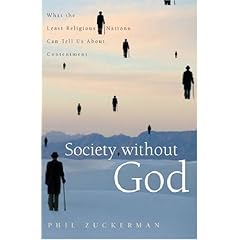
Paul Bloom of Slate magazine writes that, in general, atheists are mean and selfish, whereas believers are nice and generous.
The article makes some interesting points. One premise why believers in God tend to be more happy is that they believe they are never alone, or that God is watching them. But as Phil Zuckerman recently demonstrated in his book, Society Without God, countries that have a high rate of atheists, such as Denmark and Sweden commit far fewer violent crimes than the United States.
As Bloom writes:
So, this is a puzzle. If you look within the United States, religion seems to make you a better person. Yet atheist societies do very well—better, in many ways, than devout ones.
I agree with Bloom in that the answer lies in the community. Danes and Swedes have strong communities despite their lack of supernatural belief, and those communities have social benefits. American atheists, however, are often excluded from community life by their religious neighbors. As Bloom concludes:
The sorry state of American atheists, then, may have nothing to do with their lack of religious belief. It may instead be the result of their outsider status within a highly religious country where many of their fellow citizens . . . find them immoral and unpatriotic. Religion may not poison everything, but it deserves part of the blame for this one.
Subscribe to:
Comments (Atom)

 Posts
Posts

